
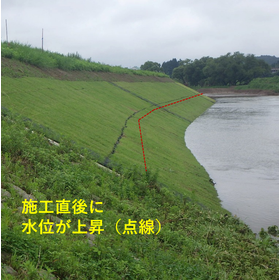
An example of a vegetation revetment method that withstood increased water levels (heavy rain) immediately after construction.
Examples of coastal protection methods that respond to increasing heavy rainfall (linear precipitation zones, typhoons, rainy seasons, etc.)! Compatible with a flow velocity of 5 m/s, similar to connected blocks. Numerous examples of disaster recovery.
This is an example of river construction where water levels rose due to heavy rainfall from the rainy season front in Reiwa 6, immediately after completion of the work. Over two days, more than 269mm of rain fell, exceeding the flood warning level. Although the grit saver was submerged during this record-breaking rainfall, no damage such as peeling or suction was observed. Strengthening of levees and riverbanks, measures against backflow, and the use of retention basins and adjustment ponds are all effective. The grit saver is produced by intertwining the roots of wild grass with grit nets in production fields. It has flow resistance up to 5m/s even against temporary increases in water level before establishment. 【Cost Reduction and Shortened Construction Period】 Compared to conventional technology, costs are reduced by 43%! Construction time is shortened by 64% (concrete block laying + covering soil + turf laying). It is more economical compared to other methods with equivalent riverbank functions (such as interlocking blocks). Since both riverbank construction and greening work are completed in a single process of laying, the construction period can be shortened. 【Ease of Construction】 No special tools are required, making construction easy. The grit saver is lightweight, allowing for clean construction without exhaust emissions even in residential areas. Since cranes and other equipment are not needed for construction, it can be carried out in rivers where temporary yards cannot be secured.
- Company:日本植生
- Price:Other
